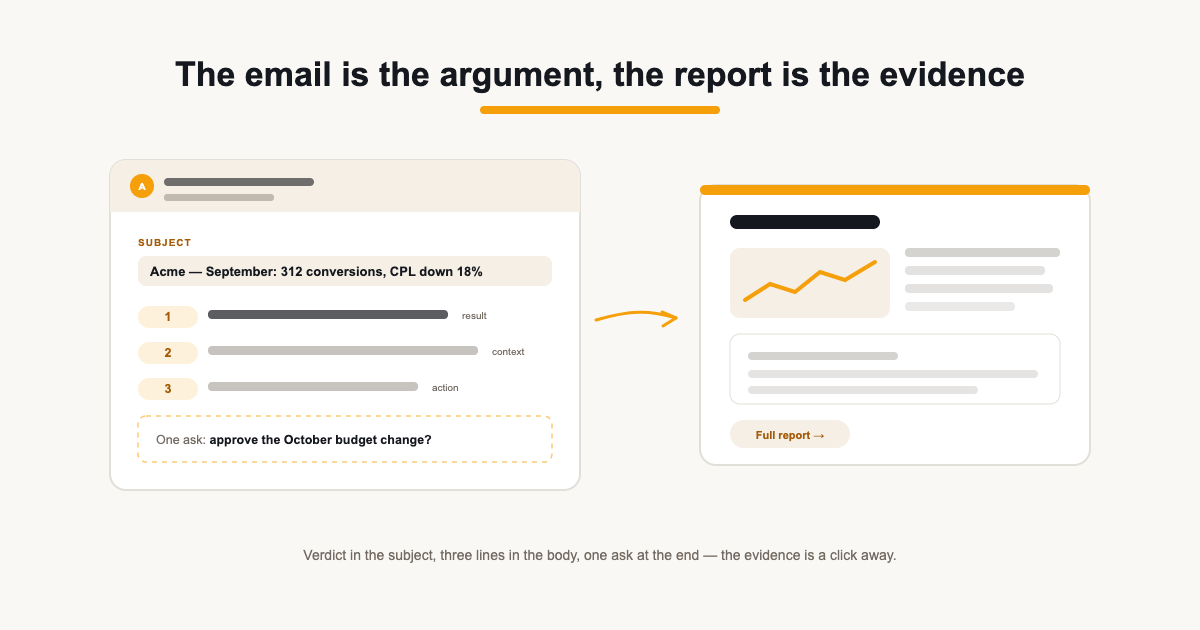
In brief
- The subject line carries the verdict — 'September PPC: 312 conversions at £13' beats 'Monthly report'.
- The body is three lines: the result, the context, the action. The report is where the evidence lives.
- End with one ask — a question, an approval, a call — not 'let me know if you have questions'.
Contents
A client report never arrives alone — it arrives inside an email, and that email decides whether the report gets read at all. 'Please find attached this month's report' tells the client the work is in the attachment and the sender thinks their job is done. It is the wrong way round: the email is the argument, the report is the evidence.
The good version is short, specific and opinionated. It takes two minutes to write once the report exists, and it is the difference between a report that gets read and one that gets archived on arrival.
Why the email matters more than the report
Clients triage their inbox by sender and subject. A subject line that says 'report' tells them the email is long and homework-shaped; a subject line with the month's verdict tells them reading it will take twenty seconds. Most clients will only ever read the email — which is fine, if the email contains the actual answer. The report then exists for the day they want to dig, and for the audit trail.
It is also how the client forwards the work internally. Your report goes to a marketing manager who reports to a director who has never opened it — the email is what they forward. A three-line summary under a verdict subject line is the version of your work that reaches the person approving the retainer, so write it as if they are the only reader.
It is also the record. When a client asks in six months why spend went up in September, the answer is in a sent email, not in a dashboard they have to remember how to log into.
The subject line carries the verdict
Formula: client, period, headline result. 'Acme — September: 312 conversions, cost per lead down 18%' is opened. 'Acme monthly report September' is not. The subject does not sell the report — it delivers the month's result at inbox-scanning speed, and the client who reads only the subject still got the answer. A subject line is doing its job when the client could repeat the month's result from memory an hour later without opening anything.
Three lines: result, context, action
- Result — the one number that matters this month, with its delta. 'Conversions up 14% to 312.'
- Context — why it moved, in one sentence. 'The expanded audience from August is converting at target now.'
- Action — what happens next. 'We are keeping spend flat and refreshing the top creative next week.'
Three lines is the whole email. Bad months get the same shape — result, what caused it, what you are doing — which is exactly when the email matters most. A client who sees 'leads dropped, here's why, here's the fix' in three lines does not send the follow-up email. The shape also survives delegation: any account manager can fill result-context-action without needing to write well, which is what makes it a system rather than a talent.
End with one ask
Every report email ends with a single request: approve the budget change, sign off the new creative, book the quarterly review, or simply 'does this match what you saw your side?'. 'Let me know if you have any questions' is not an ask — it is the absence of one, and it gets the reply it deserves.
The bad-month version
Bad months are where the format proves itself. The temptation is to bury the number under caveats; the right move is the same three lines, harder. 'Leads fell 22% — CPCs spiked when a competitor entered the auction — we have paused the two worst ad groups and moved that budget into the brand campaign.' That is the whole email. A client who gets that does not send the worried reply, because the worry is already answered — and the report behind it shows exactly where the drop came from.
The agencies that lose accounts over bad months are usually not the ones with bad numbers — they are the ones whose emails went quiet. Silence reads as 'we did not notice' or worse, 'we noticed and hoped you would not'. Write the bad-month email first, not last.
Send it when they will read it
Tuesday to Thursday morning beats month-end Friday afternoon — a report that lands while the client is still in their own week gets read; one that lands at 5pm on a Friday gets the Monday archive sweep. Whatever day you choose, keep it: a client who learns 'the report comes on the first Wednesday' builds a habit around it, and habits are what retention is made of.
- Same day, same time, every month — the cadence is part of the service.
- Morning sends outlive afternoon sends in open rates.
- If the send slips, say so in the email — a day-late report with an explanation beats a silent one.
What the email is not
It is not a summary of the whole report — that is what the report is for. It is not a marketing newsletter with the report attached. And it is not optional: an unsent email is a report nobody opened, which is the same as a report nobody wrote. Three lines and an ask, every month, attached to a link the client can forward — that is the deliverable.
A worked example
Subject: 'Acme — September: 312 conversions, CPL down 18%'. Body: 'Hi Sam — September came in well: 312 conversions at £13.21 each, down from £15.04 in August. The broader audience we expanded into is converting at target now, so the efficiency dip you saw mid-month recovered on its own. We're keeping spend flat and refreshing the top two creatives next week. Report's attached — the platform pages have the campaign detail. One thing: are you happy for us to keep the expanded audience running through October?'.
Ninety seconds to write, once the report exists — and it contains everything the client needs even if they never open the link. That is the bar: the email alone carries the month; the report carries the proof.
Related guides
Put it into practice
ReportingBee turns connected marketing data into branded client reports — refresh the figures, write the commentary, send the link.